Eco-PIK - Sewage sludge as an energy source for small and medium-sized sewage treatment works - Funding project
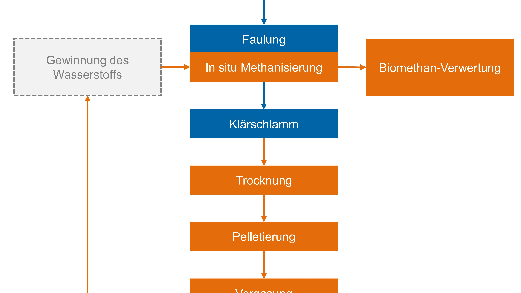
The Eco-PIK collaborative project, coordinated by the bifa Environmental Institute, investigated eco-efficient, process-integrated sewage sludge recovery for small and medium-sized sewage treatment works. The process involves a combination of sewage sludge gasification, in-situ biological methanisation and a flexible micro-gas turbine process.
In three sub-projects, the Blue Energy Group, Augsburg University of Applied Sciences and the bifa Environmental Institute investigated the feasibility of process-integrated sewage sludge utilisation for sewage treatment works with a population equivalent (PE) of between 100,000 and 300,000. The Blue Energy Group investigated whether sewage sludge pellets could be converted into synthesis gas in a modified fixed-bed gasifier. This was achieved using both air and a steam-oxygen mixture as the gasification agent. For subsequent biological utilisation, gasification using a steam-oxygen mixture is advantageous, as the product gas contains little nitrogen and a high proportion of hydrogen.
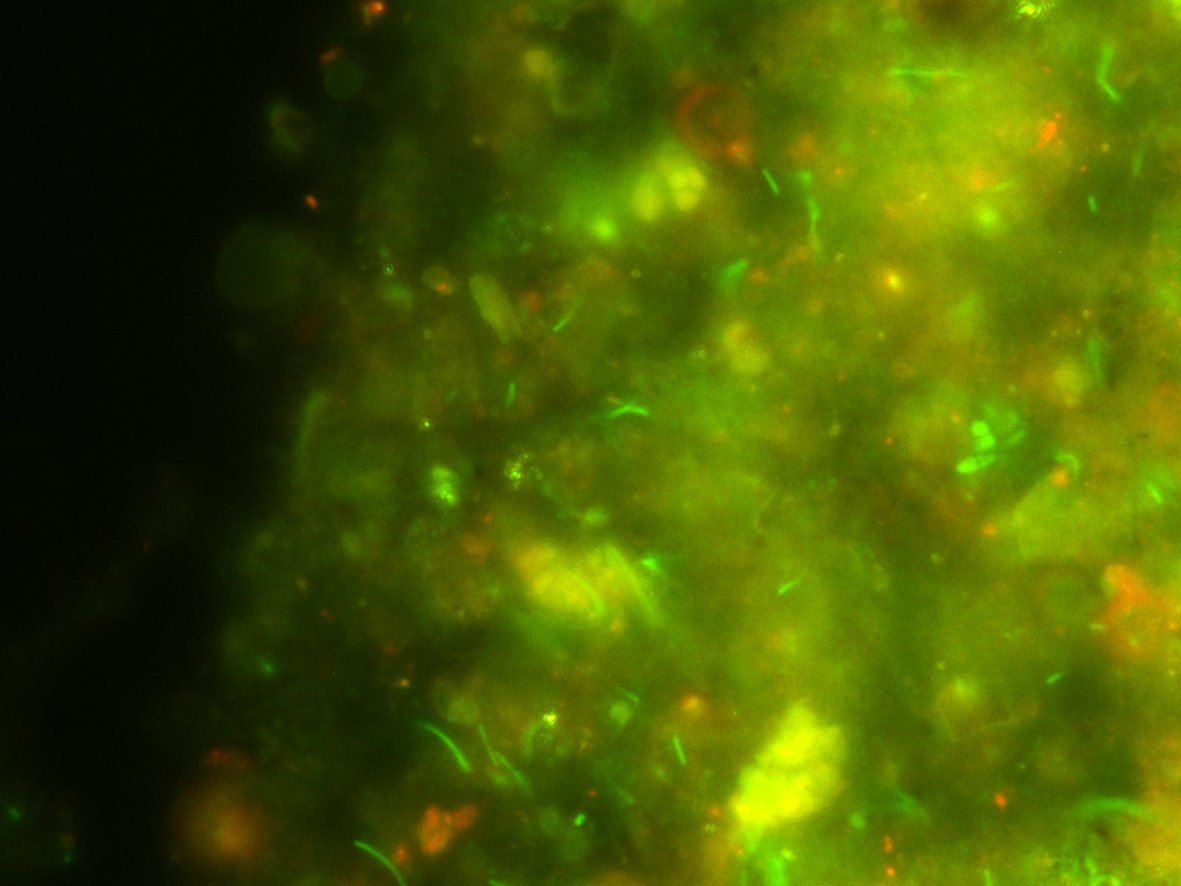
In addition to high-energy gases (hydrogen, carbon monoxide, methane), the syngas produced contains numerous other components, the extent to which these might influence the biological degradation processes in a digester was unknown. The aim of the investigations carried out by the bifa Environmental Institute was to utilise the synthesis gas for in-situ biomethanisation in the digester tower of a sewage treatment plant. The dosing of the gaseous co-substrate was not to adversely affect the primary function of the digester tower, namely the biological stabilisation of the raw sludge. To this end, numerous test series were carried out using batch cultures adapted for gaseous substrates and laboratory digesters operated under conditions simulating real-world practice. The tests examined whether both the dosed raw sludge and the dosed gaseous substrates were biologically converted into methane-rich biogas. The laboratory experiments carried out by the bifa Environmental Institute showed that, by feeding synthesis gas and hydrogen into the digester, a digester gas with a biomethane content of over 95 per cent can be produced (in-situ biomethanisation). No adverse effects on raw sludge stabilisation were observed in this process. Supplementary molecular biological analyses also revealed no changes in the bacterial composition of the digested sludge relevant to methane formation. If the unmodified synthesis gas is to be methanised in the digester tower together with the biogas produced from the raw sludge, the addition of external hydrogen is necessary.
Augsburg University of Applied Sciences subsequently modelled the flexible energy utilisation of the methane-rich product gas in an optimised micro-gas turbine.
Two scenarios for practical implementation
Based on the results of the sub-projects, the bifa Environmental Institute carried out life-cycle assessments of numerous utilisation scenarios. Taking the ecological and economic analyses into account, it became apparent that the process-integrated utilisation of sewage sludge is ecologically beneficial for sewage treatment plants. The use of externally produced hydrogen is not economically viable due to the currently high production costs. Two implementation scenarios were therefore developed for the process-integrated sewage sludge utilisation route, which do not require the use of external hydrogen and are thus economically feasible. Through the process-integrated utilisation of sewage sludge, the treatment plant has access not only to the energy from the biogas produced from raw sludge but also to the energy from the synthesis gas generated from the sewage sludge, thereby roughly doubling its own energy production.
In Scenario A, the pelletised sewage sludge is converted into synthesis gas in a fixed-bed gasifier, which is then used directly for energy. In Scenario B, the hydrogen component of the synthesis gas is used to convert all the carbon dioxide from the biogas produced in the digestion tower into methane (in-situ biomethanisation).
In terms of energy balance, both scenarios enable the sewage treatment plant’s energy requirements to be met in full. Whilst Scenario A generates additional surpluses of electrical and thermal energy, Scenario B produces surplus biomethane, which could be fed into an existing natural gas network. As demand for biomethane is expected to rise in future for the operation of domestic gas heating systems, this scenario offers significant potential for utilisation, particularly in the long term.
-----------------------------------------------------------------------------------------------------------------------------
Funding code: 03El5441A
Support programme: Zuwendung aus dem Bundeshaushalt, Einzelplan 09, Kapitel 03, Titel 68301, Haushaltsjahr 2022
Funding priority: Kombination einer Klärschlammvergasung mit einer biologischen Methanisierung und einem flexibilisierten Mikrogasturbinenprozess; Teilvorhaben: Methanisierung
Project duration: 06.2022 – 05.2025
Funding: Bundesministerium für Wirtschaft und Klimaschutz
Projectpartner: Blue Energy Europe, Hochschule Augsburg
-----------------------------------------------------------------------------------------------------------------------------